

Transport Visa-Free Regime with the EU: How the Carriage Liberalization Agreement is Changing Ukraine’s Logistics
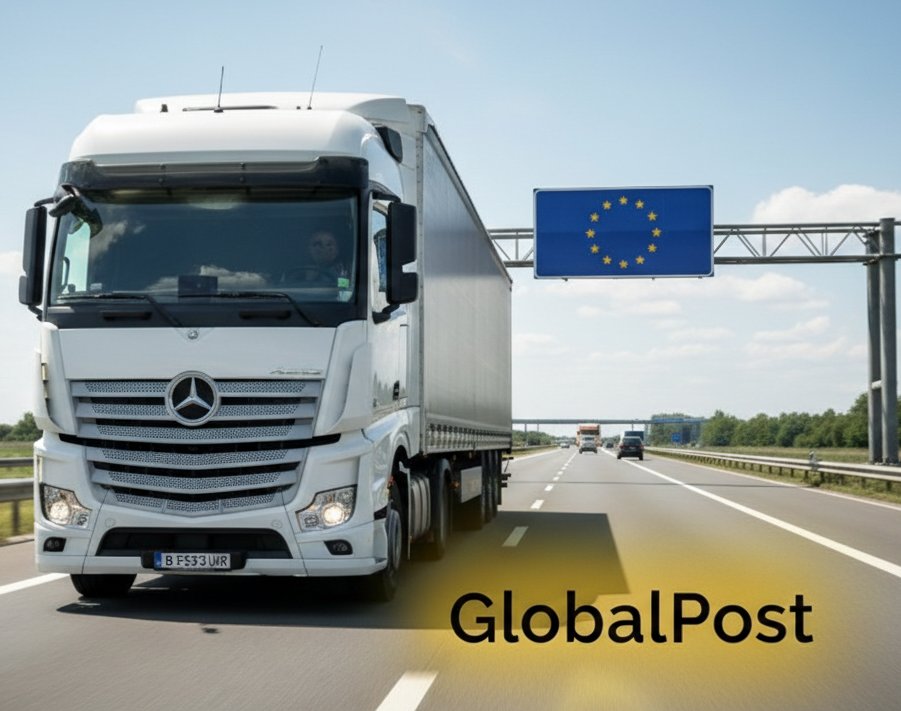
The agreement on the liberalization of freight transport between Ukraine and the EU (“transport visa-free regime”) has been extended until March 31, 2027. During the period of the agreement, trade between Ukraine and the EU by road transport has increased by 55%, with exports rising by 42% and imports by 37%. By the end of 2026, Ukraine is set to implement new standards: smart tachographs, requirements for companies’ business reputation, and training for managers. For businesses sending or receiving goods from Europe, this means simplified logistics but with new rules of the game. GlobalPost provides cargo delivery to and from the EU through commercial carriers FedEx, DHL, and UPS.
Source: Official communication of the Cabinet of Ministers of Ukraine.
What is “Transport Visa-Free” and Why is it Important?
“Transport Visa-Free” is the Agreement on the Liberalization of Freight Transport by Road between Ukraine and the European Union, signed on June 29, 2022. The agreement was concluded as a response to Russia’s full-scale invasion, which destroyed traditional logistical chains and blocked seaports.
The essence of the agreement: Ukrainian and European carriers can perform bilateral and transit freight transport without special permits. Until 2022, a quota or an ECMT permit had to be obtained for each trip-a process that complicated and increased the cost of logistics.
The agreement became part of the EU’s “Solidarity Lanes” program, the total trade volume within which exceeded 230 billion euros. In addition to the EU, Ukraine has signed similar agreements with Norway, Moldova, Montenegro, Turkey, and North Macedonia.
Chronology: From a Temporary Agreement to Systemic Integration
Traditionally, the agreement was signed for one year with the possibility of extension. Here is how it evolved:
| Date | Event |
|---|---|
| June 2022 | Signing of the Agreement on the Liberalization of Freight Transport between Ukraine and the EU |
| June 2024 | Third extension for one year (until June 2025) with automatic prolongation |
| April 2025 | Automatic extension until the end of 2025 based on positive monitoring results |
| September 2025 | Fifth extension for 15 months – until March 31, 2027 |
How Transport Visa-Free Changed Trade: The Numbers
The results of the agreement are best illustrated by the figures. According to the Ministry for Communities and Territories Development:
- The share of trade between Ukraine and the EU by road transport increased by 55%
- Exports of Ukrainian goods by road to the EU increased by 42%
- Imports of goods from the EU by road increased by 37%
- Import volumes increased by approximately 300,000 tons per month (according to European Commission data)
- Truck exports grew by 40% in 2022 and 30% in 2023 compared to the pre-war year of 2021
These indicators prove that road transport has become the primary channel for Ukraine’s foreign trade with Europe, partially compensating for the losses caused by the blockade of seaports and the destruction of railway infrastructure.
What Changes for Business in 2026: New Requirements
The extension of the agreement until 2027 is not just about maintaining the status quo. Ukraine has taken on specific obligations to adapt to European standards. By the end of 2026, three key changes must be implemented:
- Smart tachographs for new trucks. Starting July 1, 2026, all new freight vehicles registered in Ukraine must be equipped with smart tachographs – devices that record the driver’s working time, speed, and route. The requirement applies to all new registrations, regardless of the vehicle’s year of manufacture or environmental class. Trucks already in operation are not affected by this requirement.
- Company business reputation system. Under the new rules, all carriers will be considered to have a good business reputation by default. Future status will depend on violations. Effectively, this is a new verification system designed to filter out companies operating “in the shadows” or systematically violating transport rules.
- Training for transport company managers. An EU requirement regarding the qualification of transport company management personnel. In practice, this creates a new segment of educational services and raises the barrier to entry for the international transport market.
What This Means for Ukrainian Businesses Trading with the EU
Transport visa-free affects not only carriers but the entire supply chain – from the manufacturer to the final buyer.
Benefits for Business:
- Faster Delivery. The absence of a permit procedure shortens logistics time. A truck can set off on its route as soon as it is loaded, without waiting for a quota.
- Lower Transport Costs. Without the need to purchase or exchange permits, the cost of a trip decreases. This directly impacts the cost price of import and export goods.
- Predictability. The agreement through 2027 gives businesses a planning horizon – logistics chains can be built without the risk of a sudden return to the permit system.
- Competitiveness in the European Market. Ukrainian exporters receive equal conditions with European companies, which is critical for thin-margin segments: agricultural products, textiles, and components.
Challenges to Prepare For:
- Increased Competition. Freedom of movement works both ways-European carriers also have free access to the Ukrainian market.
- Documentation Requirements. Drivers must carry an extract of their license in English with a QR code, cargo documents, and a sticker on the windshield confirming the right to use the benefits of the agreement.
- Adaptation to Euro-Standards. For companies that have operated under “old” rules until now, the new requirements for tachographs and reputation mean additional investments.
How to Organize Delivery to and from the EU Right Now
For businesses that do not have their own fleet or work with small batches of goods, transport visa-free primarily means improved working conditions for logistics partners.
GlobalPost provides cargo delivery to and from the EU through a network of commercial carriers – FedEx, DHL, and UPS. For GlobalPost clients, transport visa-free means even faster times and lower delivery costs across Europe. Additionally, the company provides intermediary services for paying invoices to foreign suppliers and full support for import and export operations.
What we do for clients:
- Organize cargo delivery to all 27 EU countries and vice-versa
- Handle customs clearance and documentation
- Pay invoices to foreign suppliers on behalf of the client
- Work with all types of cargo: from parcels to pallet shipments
What’s Next: Perspectives After 2027
The Ministry of Development is already working on a roadmap for extending transport visa-free after March 2027. By November 2026, Ukraine must implement key European integration obligations to confirm compliance with EU standards.
In a broader context, transport visa-free is part of Ukraine’s sectoral integration into the EU and a prerequisite for future membership. Each successful extension of the agreement brings closer the moment when the free movement of goods becomes a permanent norm rather than a temporary measure.
For business, the conclusion is simple: transport visa-free is a window of opportunity that should be used right now. Companies that build efficient logistics chains with the EU today will have a competitive advantage tomorrow.
Need delivery to or from the EU?
Submit a request on the GlobalPost website — we will calculate the cost and delivery time for your cargo. We work with FedEx, DHL, and UPS throughout Europe.
Calculate shipping cost →
Recent posts



What exactly does the "transport visa-free regime" provide for Ukrainian business?
How long is the carriage liberalization agreement in effect?
Are permits required for transporting goods to non-EU countries?
How does GlobalPost help with cargo delivery under the new rules?
Recent posts


